
Why GEO has become distinct work
Research entry points are expanding. The familiar path was to enter keywords, scan results, and visit websites. People now also ask complete questions and let a search or model interface summarize the first answer.
Generative systems need to reconcile entities, facts, dates, conditions, and perspectives across sources. A company website built mainly from slogans, images, and disconnected news is a weak source for that job.
The main difference between GEO and SEO
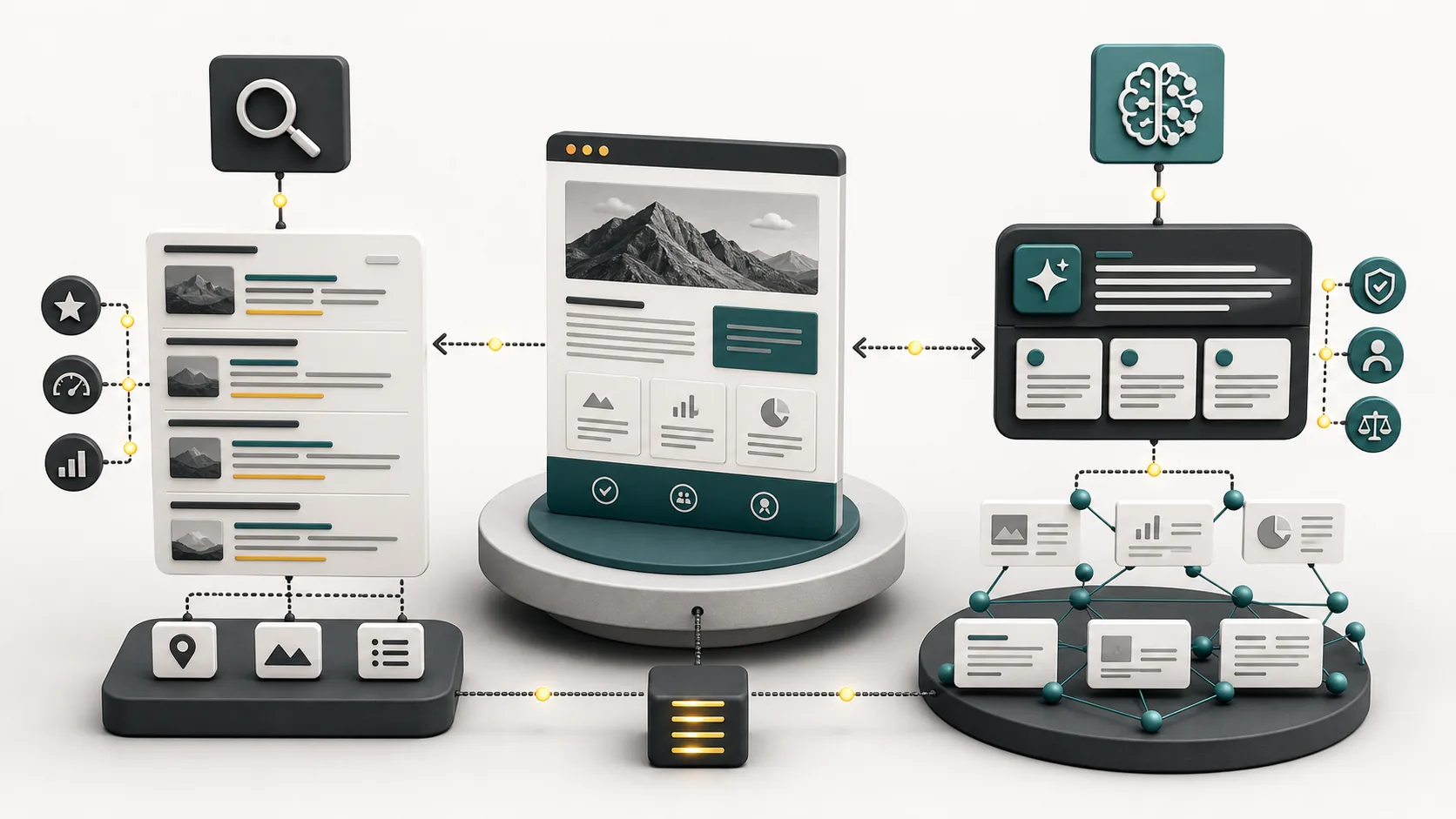
SEO usually works on visibility in search result pages: make pages crawlable, indexable, and relevant to queries. GEO works on the generated answer process: make the company, its offers, fit, limits, and public evidence understandable.
The disciplines still overlap. Pages that cannot be crawled, load poorly, conflict on canonical URLs, or duplicate languages also weaken GEO. Direct, evidence-led pages can improve both conventional search and user experience.
In simple terms, SEO helps people find and enter the website. GEO helps AI understand, check, and cite its information.

What a GEO project does
- Map questions asked during awareness, comparison, selection, implementation, and risk review.
- Explain how the company, services, products, technologies, use cases, cases, and responsible people relate.
- Record the source, update date, limitations, and reviewer for important claims.
- Build service, product, case, FAQ, and guide pages that answer directly.
- Express relationships through HTML, links, canonicals, hreflang, and structured data.
- Monitor crawling, indexing, queries, brand presence, citation signals, and leads.
What GEO is not
GEO is not daily mass publishing, repeated “AI search” keywords, or a thin page for every question. It cannot guarantee that a model recommends a brand on a particular day because retrieval sources and answer policies are controlled externally.
Where a company should start
Use an audit to answer three questions: can the site be crawled reliably, do core buyer questions have destinations, and are material claims supported publicly? Fix the technical base when it is weak, redesign the content architecture when knowledge is fragmented, and build a GEO-first website when no suitable first-party source exists.
How to measure GEO
Start with controllable indicators: coverage, evidence completeness, indexing, publishing capability, and technical quality. Over time, combine branded queries, topic presence, cited sources, organic landing pages, and qualified leads. A one-off prompt test is a signal, not a business conclusion.
Next step
If the gap between content and technology is unclear, start with a GEO, SEO, and performance audit. If the source material is strong but the website does not answer buyer questions clearly, review GEO content optimization.